
Dashboard Decision Engine
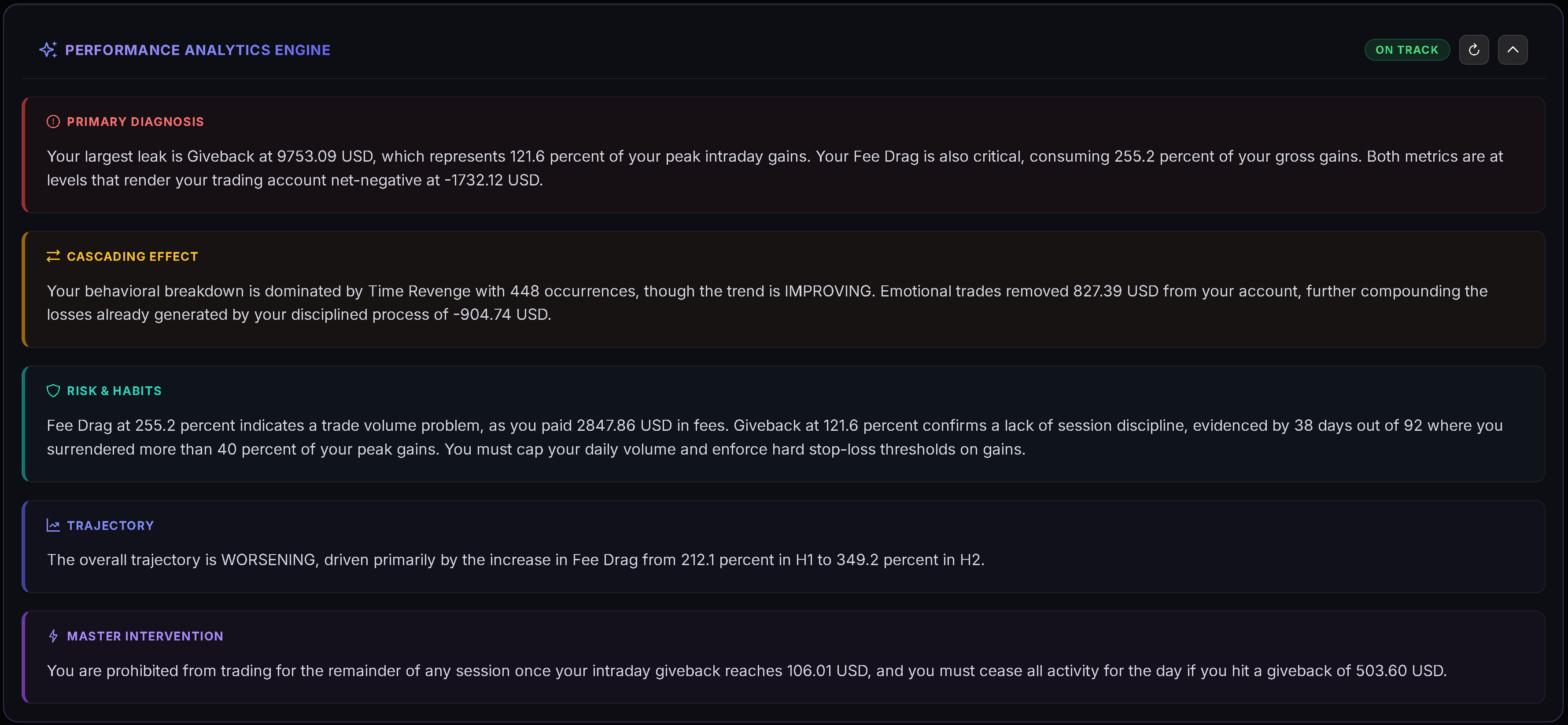
The Dashboard Decision Engine turns trade storico into a small set of decision modules. It is designed to answer three questions: what happened, what caused it, e what dovrebbe you do next. Decision Engine widgets are disponibili in il Custom Dashboard layout e influence Dashboard planning workflows.
Core Modules
Decision Verdict
Decision Verdict summarizes il selezionato periodo as Win, Loss, or Flat, then attaches il most relevant cause e a recommended action. The attuale cause categories are:
- Giveback Dominant - giveback accounts for a large share of il periodo movement.
- Overtrading - at least half of trading days were overtraded.
- One Bad Day - one losing sessione dominates il periodo result.
- Choppy / Low Edge - gains e losses are mixed with no clean advantage.
- Balanced Flat - il periodo is flat.
- Normal Variance - no stronger cause matched. Actions are consistent with il selezionato periodo context. For example, giveback can point you toward tighter exits, while overtrading can point you toward fewer round trips e clearer stopping rules.
Edge Decomposition
Edge Decomposition finds il strongest driver e biggest drag across three dimensions:
- Day of week.
- Time of day.
- Symbol. A signal deve be strong enough prima it is treated as actionable. Se a signal is meaningful, you can inspect its supporting context, review its contribution, e use it as a planning hint for il next Daily Plan.
Tomorrow Plan
Tomorrow Plan converts il selezionato periodo into a short action checklist:
- Do More - il strongest positive signal across day, time, or symbol.
- Do Less - il strongest negative signal across day, time, or symbol.
- Risk Adjustment - action based on il attuale rischio context.
- Focus Behavior - action from il Decision Verdict cause. Fai clic suing Open Daily Plan carries il attuale focus into il next Daily Plan, so il planning workflow continues from il Dashboard insight.
Risk Integrity
Risk Integrity classifies rischio as healthy, warning, or critical using il same rischio framework across Dashboard planning. It considers:
- Average winner versus average loser.
- Largest loss versus average loss.
- Win rate.
- Total trade count. Critical rischio takes priority over lighter warnings, so planning guidance stays consistent across Dashboard modules.
Regime & Context
Regime & Context fornisce il background metrics behind il decision modules:
- Trading days.
- Overtraded days e overtraded percentage.
- Total giveback.
- Worst day e best day.
- Fees e fee percentage. It recomputes when il Dashboard periodo or P&L mode changes.
Confidence And Low-Confidence States
Decision modules show stronger guidance when il selezionato periodo has enough completati trades, trading days, e clear patterns to review. Guidance becomes more cautious when il evidence is thin or il periodo is noisy. When dati is thin, modules show a low-confidence messaggio e explain how to improve il review quality. Low confidence does not hide il module; it tells il user how carefully to treat il recommendation.
Gross And Net P&L
Decision Engine respects il user’s P&L mode:
- Before fees uses gross trade P&L.
- Net subtracts commissions e fees where applicable. Questo affects periodo summaries, edge signals, rischio stats, e planning recommendations.
Articoli correlati
Serve aiuto?
Se a decision module mostra low confidence, review a broader periodo or import more trades prima making major strategy changes.
Serve aiuto?
Domande su Dashboard Decision Engine? Rispondiamo entro un giorno lavorativo.