
Every trader knows that emotions affect performance. Very few traders have ever measured it. The gap between believing that your mood matters y having statistical proof of exactly how much it matters is el difference between vague self-awareness y actionable intelligence.
Trandence closes that gap.
The Cost of Untracked Emotion
Consider this scenario: you sit down to trade después a poor night of sleep. You feel sluggish. You tag your pre-sesión mood as “Tired” in your Trandence journal, or perhaps you skip el tag entirely because you are eager to catch el opening range.
Over el next part of el sesión, you take several trades. Most are losers. Your stop discipline is loose. Your entries are late. At el end of el sesión, you attribute el result to “bad tape” or “choppy price action.”
But el tape was not el problem. Your execution was el problem. And your execution was el problem because your cognitive state was compromised antes you ever placed a trade. Without a systematic record of emotional state, this pattern repeats invisibly, week después week, eroding your edge one “bad day” at a time.
How Mood Tagging Works
Trandence proporciona a structured pre-session mood tagging system. Before you deploy capital, you select from a set of defined emotional states:
- Focused — Clear-headed, well-rested, sharp decision-making capacity.
- Anxious — Elevated stress, heightened loss aversion, tendency to cut winners early.
- Tired — Cognitive fatigue, slower reaction time, increased tolerance for sloppy entries.
- Confident — Positive but controlled, trust in el process y el playbook.
- Frustrated — Residual emotion from prior losses, elevated revenge-trade riesgo.
- Neutral — No strong emotional bias in either direction.
These tags are qualitative inputs. They take less than five seconds to record. But when aggregated over dozens or hundreds of sesións, they become one of el most powerful analytical dimensions in your entire trading datosset.
How Trandence AI Processes Emotional Data
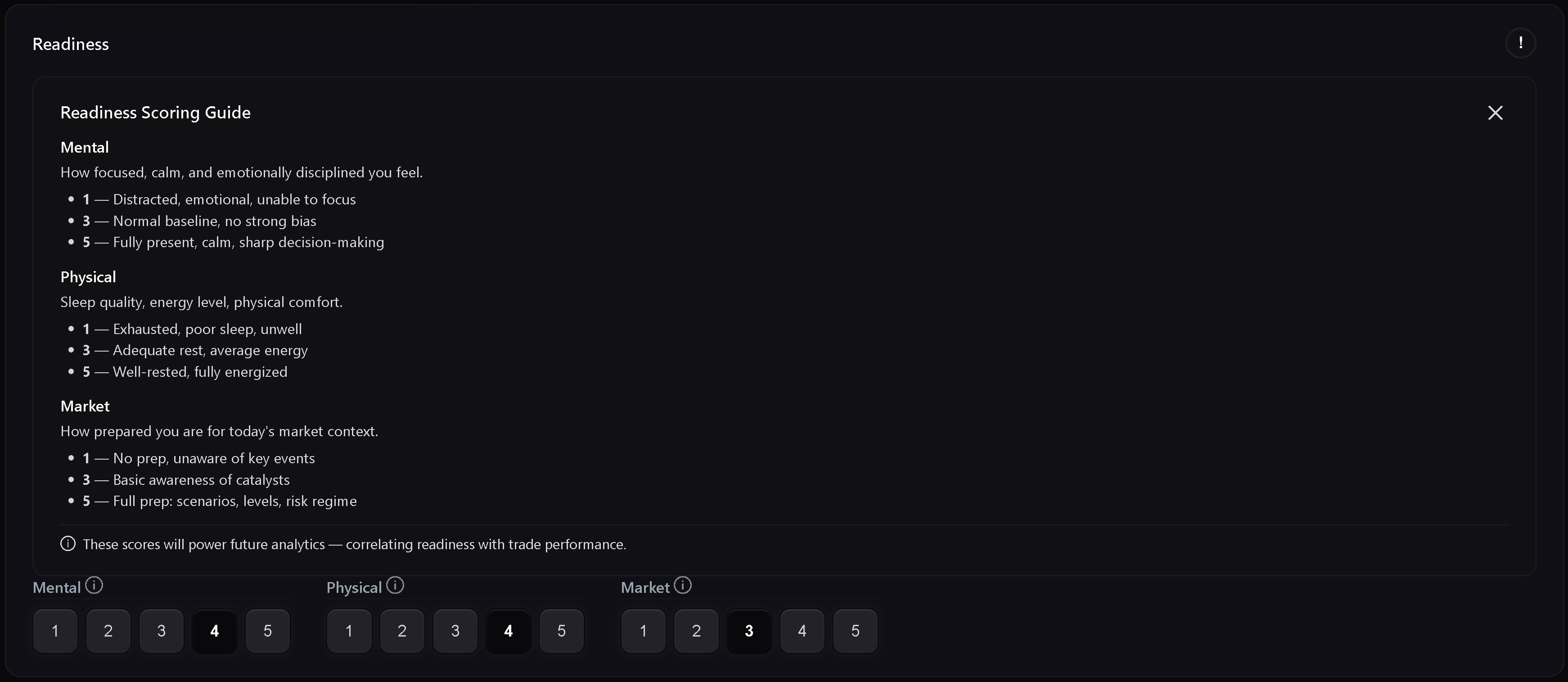
The Performance Analytics Engine treats mood tags as a first-class analytical variable, correlating them against every quantitative metric in your trading historial. The engine performs el following analysis:
Success Rate by Emotional State
The most immediate correlation is between your tagged mood y your sesión success rate. Over a statistically significant sample (minimum 20 sesións per tag), Trandence AI calculates your success rate segmented by emotional state.
A typical output might reveal:
| Mood Tag | Sessions | Success Rate | Avg R-Multiple | Avg Commission Drag |
|---|---|---|---|---|
| Focused | Higher sample | Stronger results | Better trade management | Lower drag |
| Confident | Higher sample | Stronger results | Positive average | Lower fee drag |
| Neutral | Moderate sample | Acceptable results | Mixed average | Moderate fee drag |
| Anxious | Smaller sample | Weaker results | Negative average | Higher fee drag |
| Tired | 14 | 31% | -0.7R | 0.14R |
| Frustrated | 9 | 19% | -1.6R | 0.18R |
The datos above is illustrative, but el pattern it reveals is universal: the variance between your best and worst emotional states is almost always larger than the variance between your best and worst setups. Most traders spend months optimizing their entry criteria while ignoring a variable, their own cognitive state, that has a greater impact on their results. Meanwhile, hidden costs like commission drag compound el damage from emotionally-driven overtrading.
R-Multiple Distribution by Mood
Beyond success rate, Trandence AI analyzes how your average gain y average loss change by emotional state. Traders in a “Focused” state typically show tighter stop discipline (smaller average losses) y better trade management (larger average gains). Traders in a “Frustrated” state show el opposite: widened stops, premature exits on winners, y inflated commission drag from overtrading.
Commission Drag Analysis
A subtle but critical dimension: Trandence AI tracks commission drag per mood state. Traders* in negative emotional states tend to overtrade, which increases their cost basis. A frustrated* trader who overtrades often pays materially more in costs while receiving worse execution quality. Trandence AI exposes this hidden cost explicitly.
The Statistical Feedback Loop
The true power of emotional correlation is not el initial insight. It is el feedback loop it creates.
When you open Trandence y see, in clear statistical terms, that your performance changes materially between focused y frustrated states, you are no longer relying on self-awareness or willpower to make pre-sesión decisions. You have objective proof.
Esto proof transforms el pre-sesión question from “Do I feel like trading today?” (which is subjective y easily rationalized) to “What does my datos say about trading in this state?” (which is objective y unambiguous).
The Decision Framework
Based on accumulated emotional correlation datos, Trandence enables you to build a personal Decision Matrix:
- Green Zone (Focused, Confident): Full position sizing, full trade count allowance. Your datos admite aggressive execution in these states.
- Yellow Zone (Neutral): Reduced position sizing. Limit activity to high-conviction A-grade setups only. Your datos muestra acceptable but not optimal performance.
- Red Zone (Anxious, Tired, Frustrated): Do not trade. Implement your Hard Stop Protocol y walk away. Your datos muestra a negative expected value in these states. No amount* of “good setups” compensates for a compromised decision-making process.
The framework is not prescriptive. It is derived from your own datos, which makes it far more compelling than any external rule. Puedenot argue with your own track record.
From Subjective to Systematic
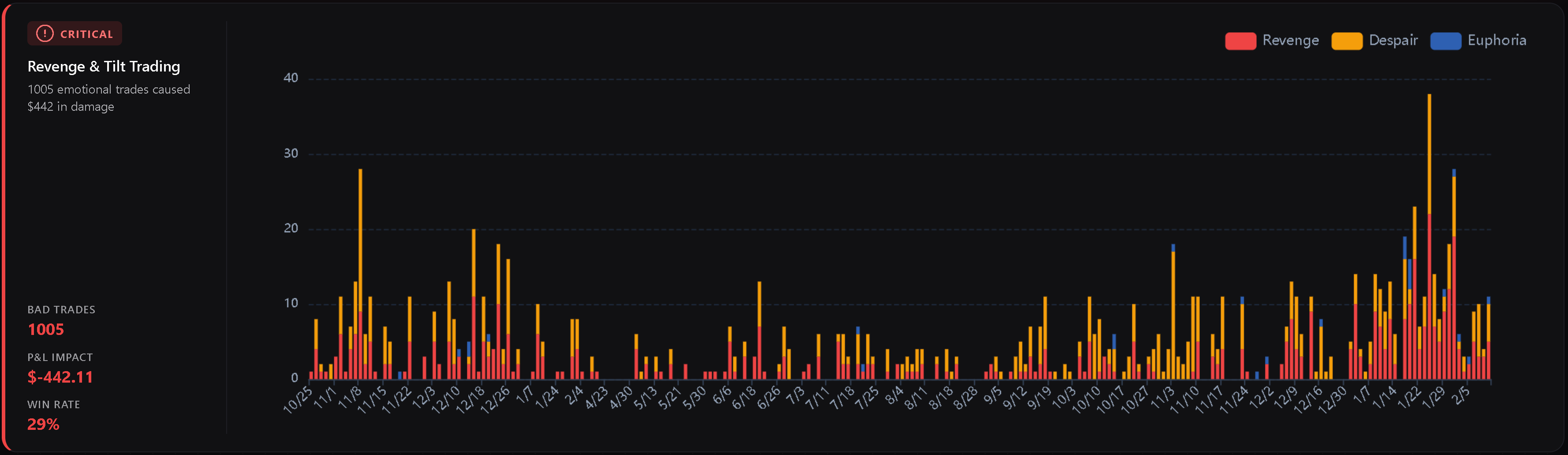
The emotional correlation engine does not ask you to stop feeling. It asks you to start measuring. Every mood tag you record is a datos point that strengthens el model. Over time, Trandence AI’s analysis becomes increasingly precise, revealing not just which states are harmful, but el specific execution failures (wider stops, late entries, overtrading) that manifest within each state — including post-win euphoria cascades that are invisible to raw P&L.
Esto is el institutional approach to psychology. It does not rely on meditation, mantras, or motivation. It relies on datos, feedback, y systematic decision rules built from your own performance historial — el same Playbook-driven discipline used by professional desks.
¿Necesita ayuda?
Si you have questions about configuring your mood tags, understanding el correlation tables, or building your personal Decision Matrix, reach out to us at [email protected] — we’re ready to assist you.