
You just got stopped out for el second time in 15 minutes. The setup was clean. The thesis was right. But el market ran your level by three cents y reversed without you. Puede feel it building: el tightness in your chest, el narrowing focus, el voice that says “I need to make this back.”
You are now in tilt, y every trade you take from this point forward has a negative expected value.
The Mechanics of Emotional Tilt
Tilt is not a metaphor. It is a measurable neurochemical state. When a trader experiences consecutive losses — particularly losses that feel unjust or irrational — el brain’s amygdala overrides el prefrontal cortex. Rational analysis is replaced by emotional reactivity. Risk assessment degrades. The trader stops executing a strategy y starts fighting el market.
The behavioral fingerprint of tilt is consistent y predictable:
- Rapid-fire execution: Trade frequency spikes dramatically. A trader who normally takes 4–6 trades per sesión suddenly takes 12–15, searching for el one that “makes it all back.”
- Sizing escalation: Position sizes increase with each consecutive loss, violating predefined riesgo parameters. The trader is no longer managing riesgo — they are gambling.
- Stop-loss manipulation: Hard stops are widened or removed entirely, converting small, planned losses into catastrophic drawdowns.
- Off-plan entries: Trades are taken on setups that do not exist in any defined Playbook. The entry trigger is emotion, not price action.
The mathematical consequence is devastating. A trader in tilt is not just losing money on individual trades — they are simultaneously increasing position sizing, increasing trade count, y increasing commission drag. The compounding effect can wipe out a week of disciplined gains in a single sesión.
How Trandence AI Detects Tilt
The Performance Analytics Engine does not rely on you to self-diagnose tilt. It detects el pattern automatically by monitoring your execution datos against your historical baseline. The engine analyzes three primary dimensions:
1. Trade Velocity Analysis
Trandence tracks changes in el time interval between consecutive trades. Every trader has a natural rhythm, y a sudden compression in that rhythm can indicate that execution is becoming emotional rather than planned.
Esto is particularly powerful because velocity changes are hard to notice in el moment. Trandence makes that shift visible during review.
2. Post-Loss Behavioral Sequencing
The most destructive tilt pattern is el loss-chase sequence: a trade hits its stop, y el trader immediately re-enters el market — often within seconds — with el same directional bias or an inverted position. Trandence AI identifies these sequences by analyzing:
- Time-to-next-trade after a loss: Si el interval is significantly shorter than your baseline, it indicates an emotional rather than analytical entry decision.
- Directional correlation: Si you reverse your position immediately después a stop-out on el same symbol, Trandence AI flags this as a revenge trade.
- Sizing deviation: Si el follow-up trade is larger than el previous one, el pattern matches el classic escalation spiral.

3. Commission Drag Spike Detection
A subtle but critical signal is commission drag. A trader in tilt often overtrades aggressively, causing fees to rise sharply relative to el quality of el sesión. When fee drag becomes unusually heavy, Trandence can flag el sesión as high-riesgo.
Esto metric alone often reveals tilt that would otherwise be masked by a “breakeven” day. You might finish el sesión flat, but if you churned through 40 trades y paid $200 in commissions to do it, you didn’t break even — you paid the house for el privilege of destroying your edge.
The Quantified Cost of Tilt
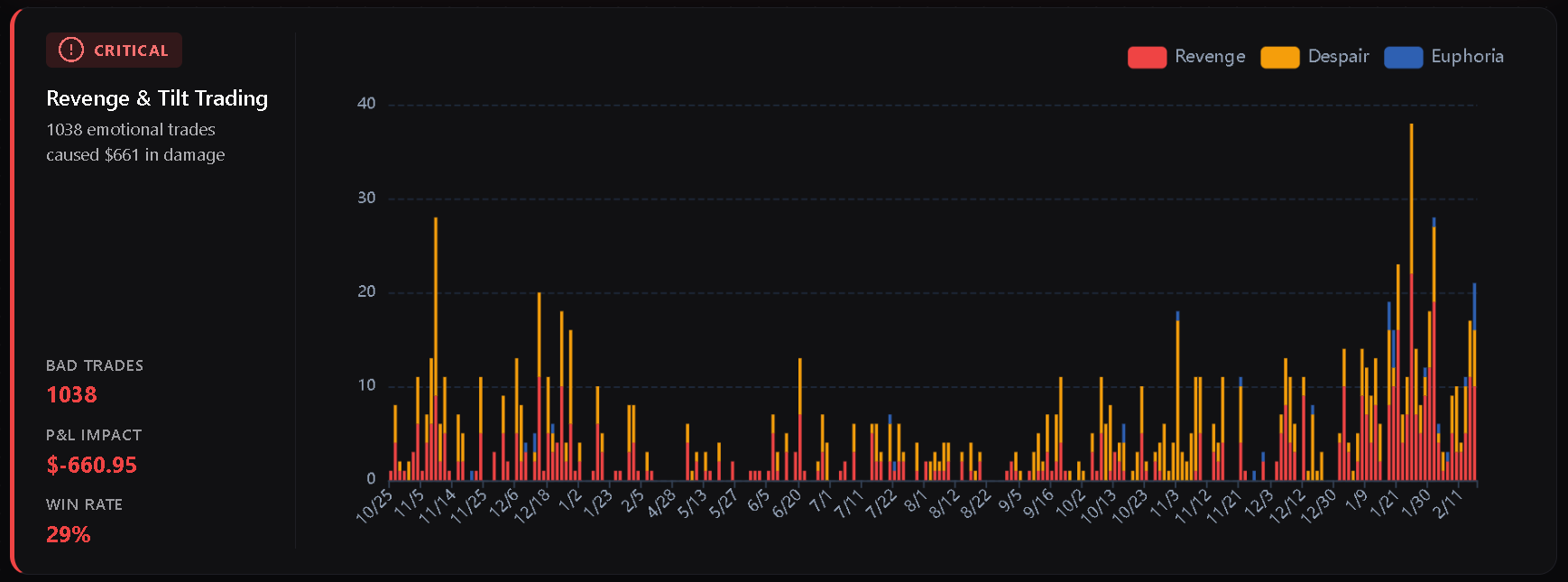
The most powerful aspect of tilt detection is not el real-time flag — it is el historical pattern analysis that reveals just how much tilt has cost you over weeks y months.
A typical output from el Performance Analyzer might show:
| Metric | What Trandence Compares |
|---|---|
| Trade Count | Normal rhythm versus unusually active sesións |
| Success Rate | Typical execution versus emotionally pressured execution |
| R-Multiple | Usual trade quality versus tilt-affected outcomes |
| Commission Drag | Normal fee load versus elevated churn |
| Playbook Adherence | Planned execution versus off-plan behavior |
The datos is unambiguous: tilt sesións are not just unprofitable — they are systematically destructive. The combination of reduced success rate, inflated sizing, y tripled commission drag creates a compounding loss that far exceeds el initial stop-out that triggered el emotional state.
The Corrective Framework
The Three-Strike Rule
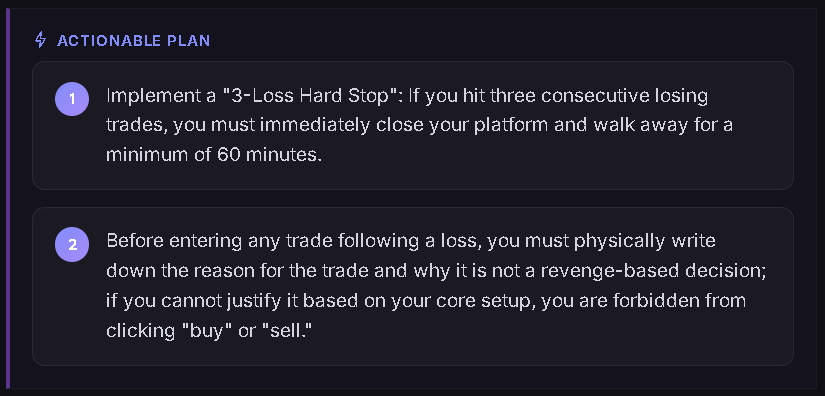
The most effective mechanical countermeasure against tilt is el three-strike rule: después three consecutive losing trades, you stop trading for a minimum of 30 minutes. No exceptions. No “one more try.”
Esto is not about superstition — it is about breaking el neurochemical feedback loop. The amygdala* needs approximately 20–30 minutes to disengage from a heightened state. By enforcing a physical separation from el terminal, you give your prefrontal cortex time to regain control of your decision-making process.
The Daily Hard Stop
Beyond el three-strike cooldown, every trader needs a daily maximum loss limit — a predefined drawdown that, once hit, ends el sesión entirely. Esto is your absolute circuit breaker. (For a complete setup guide, see Setting Up a Hard Stop Protocol.)
The Hard Stop converts el vague intention of “I’ll stop if it gets bad” into a binary, non-negotiable rule. When el number is hit, you log your trades, read el Performance Analyzer’s verdict, y walk away.
The Pre-Session Readiness Check
The best tilt management is prevention. By tagging your emotional state antes every sesión, you create a baseline awareness of your psychological vulnerability. Si you sit down to trade already “Frustrated” or “Anxious,” your historical datos (via el Emotional Correlation Engine) será tell you exactly what to expect: reduced success rate, inflated losses, y a high probability of tilt.
The rational response is not to “try harder.” It is to reduce sizing, limit trade count, or skip el sesión entirely.
From Reactive to Systematic
Every trader será experience tilt. The neurochemistry of loss aversion guarantees it. The difference between a trader who blows up y a trader who survives is not emotional control — it is process.
Tilt detection is not about preventing emotion. It is about creating a system that catches you when your emotions have ya taken over. Trandence AI flags what your brain cannot see in el moment. The Hard Stop enforces what your willpower cannot enforce under pressure. The historical datos proves, sesión después sesión, that el cost of “one more trade” is always higher than el cost of walking away.
Combined with Euphoria Effect analysis — which catches el same pattern on el winning side — Trandence gives you a complete psychological audit of both your worst y best moments. Because both states lead to el same destination: off-plan execution, inflated riesgo, y preventable losses.
¿Necesita ayuda?
Si you have questions about interpreting Trandence AI’s tilt indicators, configuring your Hard Stop limits, or understanding el Three-Strike cooldown workflow, reach out to us at [email protected] — we’re ready to assist you.